Friday, 7 January 2022

Why a ‘Girl Friendly’ toilet means more time in school

 Without access to safe, hygienic toilet facilities, many girls around the world do not go to school when they are menstruating.

To avoid missing school some girls hide used cloths in their pockets while others do not eat or drink during the day, making it impossible to learn effectively and leading to bowel and bladder problems later in life. Girls who change in the open, away from school, run the risk of sexual harassment.


Girls need a toilet space which is separate from boys – or they will not feel safe, they will avoid school and their education will suffer.

D.E.B Primary School in Western Kenya’s Bungoma County has over 1,000 disadvantaged students – orphans or from vulnerable families. Its toilet facilities were woefully inadequate and a number of toilets had to be closed due to a lack of resources and heavy rains. While overcrowding of the remaining toilets raised health and hygiene issues.

With the generous support of St. James’s Place Charitable Foundation, Ace Africa constructed two new toilet blocks at the school. One was for girls-only, with two latrines, a separate washing room, two handwashing stations and an incinerator to dispose of sanitary products.

As part of the programme 30 of the most vulnerable girls at the school received a year’s supply of sanitary towels. There were also sessions by specially trained teachers on sexual health, rights, good hygiene and nutrition. A new boys block was built with handwashing stations, ensuring the girls toilet stayed exactly that.


The girls of D.E.B primary now have a safe and hygienic space to manage their menstrual hygiene. The project assured female students could attend safely, with dignity, and no longer miss vital days of school every month.

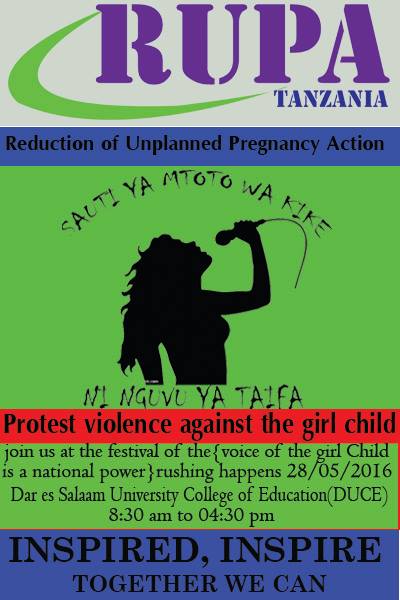
Sunday, 29 May 2016

Meneja wa banki tawi la mbagala kitengo cha huduma kwa wateja azungumza na wanafunzi katika kongamano la SAUITI YA MTOTO WA KIKE lilofanyika duce changómbe

Meneja wa benki ya NMB tawi la mbagala kitengo cha huduma kwa wateja azungumza na wanafunzi katika swala zima la kujitambua na kufwata yale wanayofundishwa na walimu wao mashuleni, amezungumza hayo jana katika kongamano lililo andaliwa na taasisi moja isiyo ya kiserikali RUPA TANZANIA hapo awali meneja huyo alligusia swala zima la wanafunzi wengi hupoteza muda katika mambo yasiyo na umuhimu ambayo hupelekea wanafunzi wengi kushindwa kufanya vzuri katika masomo yao na mwisho wa siku hujiingiza katika mambo yasiyofaha katika jamii na hupelekea kupata mimba zisizo rasmi kwaupande wa watoto wakike pia meneja huyo aliomba taasisi hiyo isiishie hapo tu kwa upande wa watoto wa kike peke yake wajaribu kuangalia na upande wapili kwani kuna baadhi ya watoto wa kiume wenye umri mdogo wanaonyanyaswa na wakubwa wao na hata wakati mwengine huwa fanyia mambo yaliyo kinyume na maumbile yao alizidi kusisitizia meneja huyo..

Meneja wa Benki ya NMB kitengo cha huduma kwa wateja tawi la mbagala akiongea na wanafgunzi

Pia Dkt Mkuu kitengo cha damu salama katika hospitali ya mbagala chamazi aliwasisitizia wanafunzi hao katika kuwa wavumilivu katika swala zima la maisha kikubwa ni kuzingatia katika masomo kwani wakisoma vizuri na kupata elimu yao ipasavyo basi huko mbeleni wataona matunda yake ya kusoma pia aliwashauri na walimu wao pia kuwapa elimu rika wanafunzi wao wa jinsia zote mbili juu ya athari za ndoa na mimba za utotoni kwani wengi wao siku hizi wanapata mimba na wahusika ni wao kwa wao "unakuta siku hizi kesi nyingi zilizopo mitaani za mimba za wanafunzi wahusika ni wanafunzi kwa wanafunzi ndiyo wanaopeana hizo mimba sasa inabidi walimu na wazazi tuliyopo hapa tushirikiane wote kwa pamoja kuwapa elimu rika vijana wetu hawa"

Dkt mkuu kitengo cha damu salama katika hospitali ya chamazi iliyopo mbagala

SAUTI YA MTOTO WA KIKE NI NGUVU YA TAIFA..


Katika swala zima la kumsaidia kumjenga mtoto wakike katika kushinda vishawishi na mambo mabaya yanayo wakabili hasa swala zima la ndoa na mimba za utotoni ambapo jamii nyingi ya kitanzania limekuwa sugu kuanzia mijini hadi vijijini. Kutokana na swala hilo taasisi ya RUPA TANZANIA ikishirtikiana na asasi nyingne zisizo za kiserikali na kiserikali pia jana lilifanya kongamano liitwalo SAUTI YA MTOTO WA KIKE la kupinga vikali vita hivyo ambapo lilipata kuudhuriwa na baadhi ya wanaharakati wanaosaidia kupigana na matatizo hayo katika jamii inayotuzunguka..Kwani mtoto wakike ndiyo chanzo cha kujenga familia katika jamii...


Baadhi ya matukio ya kongamano la SAUTI YA MTOTO WA KIKE katika picha lililofanyika hapo jana katika ukumbi wa duce changómbe wilayani temeke mkoa wa Dar es salaam...

Baadhi ya wafanyakazi wa shirika la RUPA TANZANIA, Kutoka kulia ni Bi Rehema, Bi Waldah Faham, Bi. Fatmah Mukharamy, Ndg Lazaro Musalaka, Bi. Christina Nguyu. Hao ni baadhi ya watumishi wa Rupa Tanzania.

Taasisi isiyo ya kiserikali RUPA TANZANIA yajumuika na wanafunzi katika kukamilsha agizo la mkuu wa mkoa Mh. Paul Makonda katika kufanya usafi..

Kama ilivyo kawaida katika mkoa wa Dar es salaam kila ifikapo mwisho wa mwezi huwa ni siku ya usafi kimkoa mzima wa Dar es salaam ilikukamilisha agizo la mkuu wa mkoa Mh. Paul Makonda katika siku hiyo taasisi moja isiyo ya kiserikali  RUPA TANZANIA ilikamilisha agizo hilo kwa kujumuika na wanafunzi wa shule ya msingi na sekondari  katika kufanya usafi maeneo tofauti tofauti ya wilaya ya temeke..Hapo chini ni baadhi ya matukio katika picha.


Baadhi ya wanafunzi toka shule mbali mbali za msingi na sekondari waliojumuika pamoja na wafanyakazi wa RUPA katika swala zima la usafi katika kukamilisha agizo la mkuu wa mkoa Mh. Paul Makonda, usafi huo ulifanyika katika maeneo ya chang'ombe wilaya ya temeke mkoa wa
Dar es salaam...


 Baadhi ya wanafunzi wakionekana wenye furaha huku wakielekea katika maeneo mbali mbali waliopangiwa na viongozi wao katika shughuli nzima ya usafi...


Baadhi ya wanafunzi wa shule ya sekondari chang'ombe na chamazi wakiwa katika maeneo ya ofisi ya serikali za mitaa za keko wakifanya usafi...


 Baadhi ya wanafunzi wa shule ya msingi matitu na kilamba wakiendelea na zoezi zima la usafi..


  Baadhi ya viongozi na wanafunzi wakitoka katika maeneo waliofanya usafi..

Tuesday, 1 December 2015

TEKNOHAMA KATIKA SHULE ZA MSINGI NA SEKONDARI

Mtaala ni mwongozo mpana unaoweka viwango vya utoaji elimu kwa kuzingatia maeneo yafuatayo:- maudhui na ujuzi watakaojifunza wanafunzi yaani maarifa stadi na mwelekeo, njia za kufundishia na kujifunzia zatakazotumika katika utekelezaji wa mtaala vifaa vya kufundishia  na kujifunzia vinavyohitajika sifa za kitaaluma na kitaalamu za mwalimu atakayeuwezesha mtaala miundo mbinu wezeshi katika utekelezaji wa mitaala muda utakaotumika katika ufundishaji na ujifunzaji, upimaji na ufwatiliaji na tathimini ya mitaala.

Wnafunzi wa shule ya msingi sokoni 1 wakijaribu kujifunza katika mfumo wakutumia tablet katika masomo yao ya darasani.


SIKU YA UKIMWI DUNIANI

Katika kuazimisha siku ya ukimwi duniani shirika lisilo la kiserikari RUPA TANZANIA limetembelea shule Mbalamaziwa iliyopo mkoa wa Iringa wilaya ya Mafinga, na kuweza kuongea na vijana wasomao hapo juu ya swala zima la ugonjwa wa ukimwi pamoja athari za ndoa na mimba za utotoni hii yote ni kuhakisha kwamba tatizo hili linapungua kwa kasi na kama siyo kuisha kabisa, inasemekana Iringa ni moja ya mikoa inayokumbwa na vijana wengi kutomaliza shule hasa watoto wakike kwa kukumbwa na athari za miba na ndoa za utotoni.
 Baadhi ya wanafunzi wa shule ya sekondari Mbalamaziwa wakijadili mambo yanayowakumba wanafunzi hasa wasichana katika swala zima la mimba za mashuleni

Thursday, 28 May 2015

New research from the University of East Anglia shows that an evolutionary force known as 'sexual selection' can explain the persistence of sex as a dominant mechanism for reproducing offspring.


Biologists have long puzzled about how evolutionary selection, known for its ruthless requirement for efficiency, allows the existence of males -- when in so many species their only contribution to reproduction are spermatozoa.
But research published today in Nature shows that sexual selection -- when males compete and females choose over reproduction -- improves population health and protects against extinction, even in the face of genetic stress from high levels of inbreeding.
The findings help explain why sex persists as a dominant mechanism for reproducing offspring.
Lead researcher Prof Matt Gage, from UEA's School of Biological Sciences, said: "Sexual selection was Darwin's second great idea, explaining the evolution of a fascinating array of sights, sounds and smells that help in the struggle to reproduce -- sometimes at the expense of survival.
"Sexual selection operates when males compete for reproduction and females choose, and the existence of two different sexes encourages these processes. It ultimately dictates who gets to reproduce their genes into the next generation -- so it's a widespread and very powerful evolutionary force.
"Almost all multicellular species on earth reproduce using sex, but its existence isn't easy to explain because sex carries big burdens, the most obvious of which is that only half of your offspring -- daughters -- will actually produce offspring. Why should any species waste all that effort on sons?
"We wanted to understand how Darwinian selection can allow this widespread and seemingly wasteful reproductive system to persist, when a system where all individuals produce offspring without sex -- as in all-female asexual populations -- would be a far more effective route to reproduce greater numbers of offspring.
"Our research shows that competition among males for reproduction provides a really important benefit, because it improves the genetic health of populations. Sexual selection achieves this by acting as a filter to remove harmful genetic mutations, helping populations to flourish and avoid extinction in the long-term."
To uncover this role of sexual selection, the research team evolved Tribolium flour beetles over 10 years under controlled conditions in the laboratory, where the only difference between populations was the intensity of sexual selection during each adult reproductive stage.
The strength of sexual selection ranged from intense competition and choice where 90 males competed for reproduction with only 10 females, through to the complete absence of sexual selection, with only single males and females in monogamous pairings, where females got no choice and males experienced no competition.
After seven years of reproduction under these conditions, representing about 50 generations, the study exposed the underlying genetic health of the resulting populations. The team used experimental inbreeding to reveal the relative amount of deleterious mutations that lay hidden in each population.
They found that populations that had previously experienced strong sexual selection maintained higher fitness and were resilient to extinction in the face of inbreeding -- with some populations surviving even after 20 inbreeding generations where a brother was mated with a sister in each generation.
However populations that had experienced weak or non-existent sexual selection showed more rapid declines in health under inbreeding -- and all went extinct by the 10th generation.
Prof Gage said: "These results show that sexual selection is important for population health and persistence, because it helps to purge negative and maintain positive genetic variation in a population.
"To be good at out-competing rivals and attracting partners in the struggle to reproduce, an individual has to be good at most things, so sexual selection provides an important and effective filter to maintain and improve population genetic health.
"Our findings provide direct support for the idea that sex persists as a dominant mode of reproduction because it allows sexual selection to provide these important genetic benefits.
"In the absence of sex, populations accumulate deleterious mutations through a ratcheting effect where each new mutation takes a population closer to extinction. Sexual selection helps to remove those mutations, enabling populations to persist against the threat of extinction.
"Our monogamous treatment, for example, where there was no sexual selection for 50 generations, resulted in a lower level of population health and rapid extinction when populations were challenged by inbreeding. All the populations derived from monogamous histories became extinct after just eight generations.
"By contrast, populations derived from the same ancestors and identical apart from having the opportunity for male competition and female choice at each adult stage, maintained population health and avoided extinction, with some family lines still reproducing happily even after 20 generations of inbreeding."
This research was funded by the Natural Environment Research Council, the Leverhulme Trust and the University of East Anglia.

Cornwall's teenage pregnancy rate halved since 1998


CORNWALL'S under 18 conception rate has fallen by more than half since 1998, new statistics reveal.
Data released today by the Office for National Statistics shows the number of teenage pregnancies is now less than half the baseline set in 1998 when the National Teenage Pregnancy Strategy began.
The data released today shows Cornwall’s annual conception rate to be 18.2 conceptions per 1000 women aged five to 17, a whopping 54.3 per cent decrease from the 1998 baseline of 39.8 per 1000.
This means Cornwall has not only exceeded the national target of a 50 per cent reduction in pregnancy rates, but has also outperformed the average reduction achieved across England and Wales of 40 per cent.
Today’s data release also brings Cornwall’s under 18 conception rate below 20 conceptions per 1000 for the first time and see’s Cornwall performing better than the South West average.
Cornwall Council remains committed to reducing the rate of under-18 conceptions and improving outcomes for young parents and their children through the Teenage Pregnancy Strategy and Action plan.
Teenage pregnancy is often associated with negative health outcomes for the mother and child and increased likelihood of them both living in long-term poverty.
In addition to this, many teenage conceptions are unintended.
Around half result in a termination, an avoidable burden for the young women affected.
Lex Gainsbury, who leads the Teenage Pregnancy Strategy at Cornwall Council said: “Today’s figures are fantastic news and are testament to the hard work of all our services and partners across Cornwall.
“It demonstrates that sustained effort from committed individuals at every level really makes a difference.
“We are over the moon to have achieved the national target but it is important that we do not become complacent and face the challenges ahead with the same vigour and enthusiasm as that which has got us this far.
“Evidence shows that the two factors that have the biggest impact on rates are access to young people friendly sexual health services and both formal and informal relationship and sex education, ensuring young people have the skills, knowledge and confidence to make positive choices about their sexual health now and in the future.

Friday, 24 April 2015

Boyfriend gets life for slaying of pregnant teen girlfriend

ANGLETON, Texas (AP) - An 18-year-old man faces life in prison after Southeast Texas jurors convicted him of killing his teenage girlfriend who was pregnant with twins.
Ryan Matthews was convicted of capital murder in the death of Arrijana Hill. Both Matthews and Hill were 16 when she was found dead last year in a pool of blood inside her family home in Pearland.
Prosecutors accused Matthews of killing Hill because he was worried children would ruin his future as an athlete.
Matthews admitted on the stand that he saw Hill the day of her death and that he threw away the shirt he was wearing that day.
He will be eligible for parole after 40 years.
Pearland is about 15 miles south of downtown Houston.

Wednesday, 15 April 2015

SOUTH AFRICA: Teenage pregnancy figures cause alarm


johannesburg, 6 March 2007 (IRIN) - Alarming figures released by a South African provincial education department indicate that schoolgirl pregnancies have doubled in the past year, despite a decade of spending on sex education and AIDS awareness. 

The number of pregnant schoolgirls jumped from 1,169 in 2005 to 2,336 in 2006 in Gauteng, the country's economic heartland and most populous province, according to statistics released in the provincial parliament. 

"South Africa has a huge teen pregnancy problem - one in three girls has had a baby by the age of 20," David Harrison, Chief Executive Officer of LoveLife, South Africa's largest youth-targeted HIV/AIDS campaign, told IRIN. 

In a country where HIV prevalence is 18.8 percent, the high level of teenage pregnancy has heightened concerns. According to the South African Medical Research Council (MRC), "The latest national survey into HIV prevalence recorded that 16 percent of pregnant women under the age of 20 tested HIV positive."

The problem is not equally serious in all parts of the country: on average, two to three girls fall pregnant in a typical school with 1,200 to 1,400 pupils. "But what is clear is that there are hotspots where things are horribly wrong," Harrison said. The Gauteng figures showed 71 percent of pupils pregnant at one school in Soweto, a huge township on the outskirts of Johannesburg. 

"Somehow there are schools where 60 to 70 percent of pupils were pregnant. There is no doubt that this is associated with things like gang activity, coercion and substance abuse," Harrison said, adding that according to a 2006 survey, 30 percent of girls in South Africa said "their first sexual experience was forced or under threat of force". 

But other factors are also driving the high teenage pregnancy rate in some areas. According to a recent MRC study, 'Blood Blockages and Scolding Nurses: Barriers to Adolescent Contraceptive Use in South Africa', "Nurses' attitudes were a major barrier to teenagers getting hold of contraception. The nurses were uncomfortable about providing teenagers with contraception, as they felt they should not be having sex. They responded to requests for contraception in a manner that was highly judgmental and unhelpful. The girls described it as 'harassment'". 

The study also found that social pressures often prevented young women from using contraception: "The girls felt they would only be accepted as women once they had proved their fertility - many mothers wanted their teenage daughters to become pregnant so they could have a baby at home again." 

Some observers have suggested that the child support grant provided by the state was an incentive to young girls to fall pregnant, but according to Harrison, "A recent survey of 1,500 girls aged between 15 and 24 indicated that only 2 percent cited the child-care grant as an incentive. About 25 percent just said they wanted to have a baby." Other influencing factors - accounting for 20 percent - were "social pressures and self-affirmation". 

Hassan Lorgat, coordinator of the South African chapter of the Global Campaign for Education (GCE), said it was important to understand the causes of these "disappointing figures", and stressed the need for more research. "There are no studies about the role of males in the problem," he commented. 

Education is fundamental 
The MRC study recommended "sex education at school before the age of 14, when young people become sexually active". 

This should include "information for teenagers about avoiding sexually transmitted diseases, providing detailed information about contraception and its side effects; better management and training for nurses, so they can deal sympathetically with teenagers requiring contraception and provide the necessary information and education campaigns that take away the stigma of teenage sexuality, so that girls are not afraid to ask for contraception". 

LoveLife's Harrison stressed the role of schools in curbing adolescent pregnancy: "Schoolgoing is protective. [Teenagers] not at school are more likely to fall pregnant than those at school; surveys show girls are 1.7 times more likely to use condoms when in school." 

He said there was a need to determine whether teen pregnancies in Gauteng schools were "really spiraling out of control or whether the higher figures represented improvements in reporting, or [there was] less stigma associated with disclosing a pregnancy". 

Keeping children in school was essential, Harrison said. "We need to do a better job in anticipating school leaving - that's when they [schoolgirls] become hugely vulnerable." 

Sierra Leone News: As TIDEA launches report … 34% pregnancies are teenage girls


The Executive Director of Tricia Initiatives for the Development and Empowerment of Adolescent Girls and Youths (TIDEA) Patricia Bah yesterday revealed that, recent data shows that 42% of girls have a child or are pregnant by age 18years, 26% of women aged 15-19 have already given birth, while 34% of all pregnancies occur amongst teenage girls.
This alarming statistics was revealed at the official launch of an assessment report of teenage and adolescent pregnancy, in the wake of the Ebola epidemic, at the Buxton Methodist Memorial Hall, on Charles Street in Freetown.
Further making her presentation, Madam Bah explained that the findings of the report reveal that the Ebola crisis has greatly affected adolescent and teenage pregnancy programming in Sierra Leone, and that there was an increase in adolescent and teenage pregnancy during the Ebola crisis.
She said analysis from key informants showed that key drivers of adolescent and teenage pregnancy were due to poverty, anti-social behaviours, and inattentive parenting.
Madam Bah called on all present, especially women advocate to continue to urge government to enforce laws, poor attitudes towards contraception, and the reduction in reproductive health services for pregnancy prevention.
During the assessment, she said that quality data control and analysis, helped field staff to overcome some of the many challenges, especially at rural level and an alarming figure of over 30,000 teenage and adolescent pregnancies were reported in the 44 health facilities across the Country for 2014.
The Executive Director disclosed that 58% of the pregnancies occurred during the Ebola crisis, and the overall teenage and adolescent pregnancies increased by 27% nationwide.
In almost all of the districts, Madam Bah noted that statistics show that the views among participants in the assessment were that teenage pregnancy has worsened during the Ebola crisis.
Despite this, there were isolated cases where people suggested that the Ebola situation has brought down teenage pregnancy.
Madam Bah explained that in the assessment, a family support unit officer (FSU) in Kono was of the view that teenage pregnancy has come down in the district as a result of the restriction of movement of people.
She noted that apart from the Western Area, Kenema, and Kailahun, teenage and adolescent pregnancy has not shown patterns that are significantly different from the period before the Ebola outbreak.
Launching the assessment report, the President of the West African College of Nurses (WACN), Amelia Gabba, commended the management of TIDEA for their initiative and commitment to carry out the assessment, which revealed that much more needs to be done to reduce teenage and adolescent pregnancy, nationwide.
She said TIDEA has chosen the right time to launch the report and go into action, which is in line with Government’s National Strategy on Teenage Pregnancy Reduction, which has a pillar on Gender Equality and Women’s Empowerment.
Madam Gabba, who is also a nursing sister of long years, called on government and other health partners to collaborate with TIDEA, as it is through effective collaboration, teenage and adolescent girls will be able to achieve their full potential.
Concluding the WACN President appealed that the Ebola disease should not make room for more girls to become pregnant.
As she put it “Let girls be girls, not mothers”.
By Ade Campbell

UK tops league of teenage pregnancy

Britain still has the highest rate of teenage pregnancy in Western Europe despite being one of the world's biggest users of contraceptives.
The figures, which emerged yesterday in a large- scale international study, appeared to explode claims by the sex education lobby that the UK's sky-high teenage birth rate is down to ignorance.
It showed that four out of five females between the ages of 15 and 44 in Britain - 80 per cent -use some form of contraception.
This compares to 76 per cent in the U.S., 75 per cent in France and 59 per cent in Japan.
Britain, nevertheless, has a sky-high level of teenage pregnancies, with 2.9 out of every 100 girls aged between 15 and 19 giving birth every year.
In France, where there is less contraceptive use, only 0.9 of every 100 girls aged 15 to 19 have babies, according to the survey.
The level in Germany is 1.1 per hundred girls while in Japan it is only 0.4 per hundred.
The findings suggest the huge growth in single parenthood in the UK in recent years - much of it a result of teenage pregnancy - has little to do with a lack of knowledge of sex and contraception among young people.
Recent research projects have contradicted the long-standing claim of the sex education lobby that more information and better distribution of contraceptives is needed, pointing away from ignorance as the cause of pregnancy among young girls.
Yesterday's report from the U.S. pressure group Population Action International surveyed health and reproduction statistics in developed countries and those in the Third World.
Alongside Britain the countries with the highest rate of contraceptive use are China, and, surprisingly for two Catholic nations, Spain and Italy.
The findings bear out research last year at Southampton University which found that teenage girls in Britain have a sophisticated knowledge of contraception.
For example, seven out of ten knew the morning-after pill was effective after more than 24 hours.
A report last month from Prince Charles's charity the Prince's Trust said teenage single girls on sink estates admire their peers who have given birth and often seek to copy their status and acquire the free flat they think having a baby usually brings.
The Family Planning Association insisted yesterday, however: 'Contraceptive use and teenage pregnancy are really two different issues and it doesn't help to lump them together.'
British rates of teenage pregnancy remain well behind those of the U.S. One in 20 girls there has babies each year compared to one in 34 in this country.
Last year more than 48,000 babies were born to teenage mothers in Britain.
They cost the taxpayer an estimated £125million in income support alone every year, apart from other costs such as assistance with rent and council tax.
The easy availability of contraception led to steep falls in the teenage birth rate across Europe in the early Seventies.
But while other countries continued to achieve dramatic falls Britain's has not changed since
According to a 1999 report by the Social Exclusion Unit the lack of education in sex and relationships was considered the main cause.
But the survey suggests the Prince's Trust may have been more accurate in its assumption that the attraction of financial benefits may be more to blame


Wednesday, 8 April 2015

Teen Pregnancies Have Hit an All-Time Low....


But teens still aren’t opting for the most effective forms of birth control

The United States has one of the highest rate of teen pregnancies in the developed world, with up to seven times the rate of pregnancy of countries like Swit
zerland. But in recent years, that rate has been falling. Now, new data released from the CDC shows that in the U.S. teen pregnancies have hit an all-time low, falling from 61.8 births per 1,000 teens in 1991 to 26.5 births per 1,000 teens in 2013.
The data has some big implications for both the government and young women. The CDC estimates that the United States spends approximately $9.4 billion each year on teen moms, and studies have shown that teen moms face everything from poverty to domestic violence.
But the CDC’s report also shows that though 90 percent of teens are using contraception, most aren’t using the most effective types of birth control. Officials say that Long-Acting Reversible Contraception (LARC) like IUDs and implants, which can prevent pregnancy from three to 10 years, are only being used by a handful of teens. The two main methods of birth control used by teens—birth control pills and condoms—fail more often and are forgotten more frequently, meaning they’re a less effective option for sexually active teenagers.
But though use of LARC is on the rise (teens seeking birth control opted for LARC seven percent of the time in 2013, up from just one percent in 2005), there are plenty of barriers to its use. Not many teens know much about it, and many think it’s only for older women. (For many years, doctors only recommended IUDs to women who were done with child-bearing.) And when teens seek LARC at clinics, they can be stymied by high costs, uninformed clinicians and those who mistakenly believe that IUDs and implants are unsafe or inappropriate for teen use.
That needs to change, says Hal Lawrence, CEO and executive vice president of the American Congress of Obstetricians and Gynecologists. “Long-acting reversible contraceptive methodsincluding intrauterine devices and implants—are the most effective forms of reversible contraception available and are safe for use by almost all reproductive-age women.” In a statement, Lawrence noted that long-acting contraception options are just as safe in adolescents in adults…but though the recent reduction in pregnancy rates is “encouraging,” the medical profession must continue to play a role in reducing teen pregnancy.
So where’s the highest concentration of teens who choose contraception like IUDs? In Colorado, where tens of thousands of IUDs were provided to low-income women due to a private grant, the rate of IUD use in teens who seek contraception is the highest in the nation at 25.8 percent. That’s compared to just 0.7 percent of teens who seek birth control in Mississippi.


Help put girls’ rights on the political agenda


It’s under a month until the general election and we know some ways that you can make a difference. Help transform lives across the world by keeping girls’ rights on the agenda.

Christiana stands up fights for girls’ rights in Sierra Leone.
British aid has helped over ten million children, mostly girls, go to school in the past two years. This is a great achievement and shows what we can do through aid, but the task is far from over. There are still 62 million girls who are unable to access the basic right to education.

Keep girls’ rights on the agenda

Girls have a right to live free from violence, to go to school and to have a voice in decisions that affect them. Accessing these rights gives girls the chance to achieve their potential, and we also know it helps tackle poverty.
“Without the support of British aid, Plan’s work for girls would not be possible. Therefore it’s really important that you engage with political parties about what they are going to do to ensure girls’ rights are on the agenda,” says Daniel, 15, a member of Plan’s Youth Advisory Panel.

Christiana’s story

Christiana in Sierra Leone was forced to drop out of school because her family could not afford to pay for materials. She was selling food at the local market when a man older than her father approached her for marriage. She was coerced by her family to accept, and forced to undergo FGM before marrying. She escaped the marriage after five months and eventually managed to go back to school. She is now supported by Plan’s Girl Power Project and was selected by her peers to be their president because of her goal to be an advocate for girls’ education and to speak out against early marriage, teenage pregnancy and FGM.
Girls’ rights must be part of the UK international development agenda. Here’s how you can help make sure they are.

Help us spread the message to the next UK Parliament on social media

Share this image with all your followers on Twitter, Facebook, Instagram, Pinterest and any other network you are a part of. Let them know what you want. Or tweet your MP directly. You can find your local MP’s Twitter handle using the Tweet Minister website. You may also want to print the image and keep it by the front door, for when candidates come around.

Write to your local newspaper

Use Plan’s letter template to write to your local newspaper. Contact details can usually be found on their websites – the easiest way is to search for them online. Be sure to include your own name and place, as letters will not be published without that info.

Support Because I am a Girl

Plan's Because I am a Girl campaign is the biggest girls' rights campaign in the world. The campaign tackles violence including abuse, FGM and child marriage by raising awareness and providing education.

Teen birth rate falls in US


MIAMI (US): The birth rate among United States (US) teenagers has continued to decline, but health authorities said Tuesday that even greater strides could be made if more teens used long-acting forms of contraception.

More than 273,000 babies were born to mothers aged 15 to 19 in 2013, the U

S Centers for Disease Control and Prevention said.

The teen birth rate in 2013, the most recent year in which data is available, was 26.5 births per 1,000 teenagers.

This was more than double that in 1991, when the birth rate was 61.8 births per 1,000 teens.

"Improved contraceptive use has contributed substantially to this decline," said the CDC Vital Signs report.

"A key strategy for further reducing teen pregnancy is increasing awareness, access and availability of long-acting reversible contraception (LARC), specifically intrauterine devices."

Nearly 90% of sexually active teens surveyed said they used birth control the last time they had sex.

The most common forms of contraception were condoms and birth control pills.

However, relatively few teens are opting for implants and intrauterine devices, which are the most effective kinds of birth control.

Long-acting reversible contraception use among teens was 0.4% in 2005 to but rose to 7.1% in 2013.

Of the 616,148 female teens the CDC studied in 2013, 17,349 (2.8%) used IUDs, and 26,347 (4.3%) used implants.

"LARC is safe to use, does not require taking a pill every day or doing something every time before having sex, and, depending on the method, can be used to prevent pregnancy for three to 10 years," said the CDC report.

"Less than one percent of LARC users become pregnant during the first year of use."

The American College of Obstetricians and Gynecologists (ACOG) and the American Academy of Pediatrics (AAP) have endorsed LARC as a first-line contraceptive choice for teens, the report added.

However, the CDC stressed that LARC does not protect against sexually transmitted diseases.

"The good news is that teens are taking responsibility for their reproductive health needs," said Lisa Romero, a health scientist in CDC's Division of Reproductive Health.

"We also know that teens using birth control do not often choose intrauterine devices and implants, the most effective types of birth control.

"Parents and teens are encouraged to talk with their health care professional to learn about the various types of birth control, including long-acting reversible contraception."

Thursday, 26 March 2015

About 20,000 South African children in primary and secondary school fell pregnant last year, raising concern over the seriousness of teenage pregnancy in the country, according to figures revealed on Wednesday.

The revelation during a parliamentary session prompted the Democratic Alliance (DA) to request a parliamentary briefing on plans to discourage teenage pregnancy by the Department of Basic Education.
“What is of further concern is that the number of girls who return to school after having their babies is not known,” said Sonja Boshoff, DA member of Basic Education Portfolio Committee.
High pregnancy among school children requires urgent action from the government, she said.
“Education is key to future success and without it, these young people will not have a fair chance at a better life.”
According to Boshoff, teenage pregnancy is a serious problem in South Africa and must be constructively and comprehensively addressed.
Teenage pregnancy is a serious problem in South Africa. More than a third of South African women become mothers by the age of 19, according to a 2014 report by Sam Mkhwanazi, a government health official.
Boshoff introduced how the DA-run Western Cape Department of Education (WCDE) deals with teenage pregnancy.
To ensure that pregnant learners complete their schooling, the WCED has developed a policy on Managing Pregnancy in Public Schools.
The policy provides step-by-step guidelines to schools on how to manage learner pregnancy and the roles and responsibilities of everyone involved, including the learner, the learner’s parents, the father, if the father is another learner, and the school. Enditem
Source: Xinhua

Youth offenders taught about teenage health

BACOLOD City – Twenty-five youth offenders housed at the Bahay Pag-asa Youth Center here have undergone a training-workshop on adolescent health.
They were trained on adolescence, sex, sexuality and gender, fertility awareness, risky behavior among adolescents, premarital sex, teenage pregnancy, and teen dating, said program facilitator Ernie Asoy.
Ansoy said they also discussed violence, illegal drugs, smoking, and alcoholism, as well confronting threats and risks on adolescents, responsible sexuality, and harnessing adolescent life with skills.
The training-workshop was part of the Bahay Pag-asa Youth Center’s rehabilitation program in cooperation with the city government here.
It aims to train and equip young delinquents, mostly minors, with basic knowledge in coping with adolescent life outside the center.
They undergo rehabilitation at Bahay Pag-asa before they return to their respective communities and families. (PNA)

http://www.massteenpregnancy.org/events/2015/03/26/teen-parent-lobby-day-2015

http://www.massteenpregnancy.org/events/2015/03/26/teen-parent-lobby-day-2015

MEC Weziwe Thusi calls on parents and teachers to work together to end teenage pregnancy

Source: Republic of South Africa – Press Release/Statement:
Headline: MEC Weziwe Thusi calls on parents and teachers to work together to end teenage pregnancy
KwaZulu-Natal MEC for Social Development, Mrs Weziwe Thusi, has called on parents and teachers to work together to end the high rate of teenage pregnancies in schools.
Speaking during her visit to Mphathesitha High School in Nkandla as part of the provincial government’s Operation Sukuma Sakhe, MEC Thusi said government was extremely concerned that some schools still had high rates of teenage pregnancies which had adverse effects on pupils’ academic development.
“This is a serious problem that needs a holistic approach. Teachers alone cannot deal with this challenge and we therefore call on parents to work closely with teachers so that this can be addressed, “said MEC Thusi.
Mphathesitha High School is one of the schools that have experienced a high rate of teenage pregnancies in the past few years. There were 12 pregnancies in 2013 alone and through vigorous intervention that involved parents, teachers, the Department of Social Development and NGOs, the number drastically dropped to two in 2014.
“The manner in which Mphathesitha High School has dealt with the problem of pregnancies is highly commended and it should be copied by other schools which have a similar problem. Our government will continue offering support to ensure that we end teenage pregnancies. The Department of Social Development is always ready to offer professional counselling support to pupils,” added MEC Thusi.
Teenage pregnancies did not only have adverse impact on pupils’ academic development, but they also put their health at risk getting sexual transmitted diseases such as HIV and STDs, she added.
Thusi said teachers and parents should organise sessions where pupils will be taught about the implications of getting pregnant at a young age. “These sessions should also be attended by parents and they should be conducted by professionals such as social workers and community care workers. Mphathesitha High School has done this successfully.” The MEC also donated school uniforms to needy pupils at Mphathesitha High School.